
| BELROTH | |
 | |
| (DEITY) | |
| Adjective | Belrothian |
| Realm | Threnyx, a living black hole |
| Areas of Concern | black holes, cosmic destruction, disaster, suffering |
| Worshipers | annihilationist cults, disaster cultists, the disillusioned |
| Edicts | inflict pain, ruin or destroy that which is precious to others |
| Anathema | show mercy, negotiate, surrender or accept surrender |
| Divine Attribute | Strength or Constitution |
| Cleric Spells | 1st: phantom pain, 5th: toxic cloud, 6th: disintegrate |
| Divine Font | harm |
| Sanctification | may choose unholy |
| Divine Skill | Intimidation |
| Domains | decay, destruction, pain, plague |
| Alternate Domain | sorrow |
| Favored Weapon | disintegration lash |
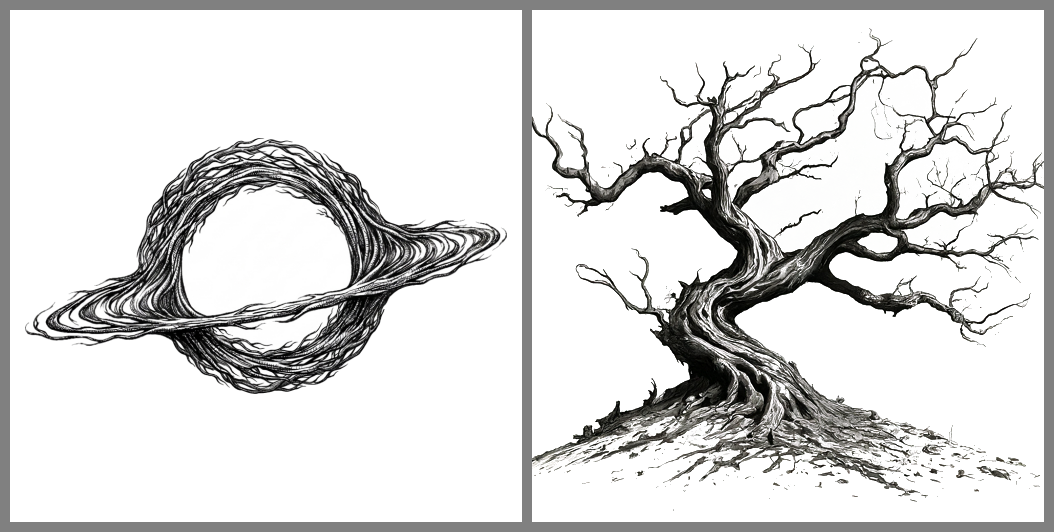
| Symbol | Black hole (or dead tree) |
| Sacred Animal | diatha |
| Sacred Colors | black (or the absence of color); rust red among cults |
The Withering
Belroth is the deity of cosmic annihilation, black holes, and universal suffering — a being who believes existence itself is a mistake that is meant to be destroyed. He is a deity gone mad with infinite rage and an unending obsession to unmake reality.
History
Origins
Belroth is an Ealdor, one of the first deities who arose spontaneously from Primal Chaos. With the others, they molded Chaos into the Divine Cosmos. Belroth’s role was that of the “shaper”, a role that involved creating all matter, energy and the fundamental forces, and dictating how they would function. It was during this time he formed and abandoned fleeting relationships with Feilona and Triceal who bore his children – Selenia, Shimai, Tylden and Zyphos.
The Cataclysm
Like all the Ealdor and most of the Eafora, Belroth slumbered deeply once Reality was fully forged. During this time, their creation spun on, with its only sentient non-deity species growing and learning. When these beings sought to capture the power hidden deep within celestial objects, their efforts resulted in the destruction of two slumbering gods – Selenia and Zyphos.
With all of the old deities now awake, Belroth flew into a rage; his fury over the loss of his children broke his mind. Without thought or hesitation, Belroth set about the total destruction of those who had murdered his family. Though mostly successful, his eternal rage continued as he found new targets, some of them the other gods.
Eventually he was calmed, relatively speaking, and seemed satisfied to simply meddle in affairs both celestial and mortal. He found pleasure in sabotaging the work of others, of sundering and bringing to ruin any and all aspects of creation that others found value in. He stoked the fires of the war between the giants and the dwarves, resulting in both ancestries being sent to Riadus as mortals. He corrupted the Wild, causing it to collapse into ineffective chaos rather than natural order. He befriended then betrayed Nayshima, transforming her from a compassionate steward of the dead into a cruel warden of the damned. After the other Ealdor confronted him after an attempt to murder the Ascended god Kairos, he tore the Rift open, exposing Reality to Primal Chaos directly.
The Chaos Wars
Though many centuries passed since the opening of the Rift, it marked the start of what came to be known as the Chaos Wars. Initially minor skirmishes between mortals and demons born from the Rift, these eventually escalated as it seemed some other entity within Primal Chaos wished to see Reality undone and return to its original state. Belroth backed the side of Chaos during these wars, though he frequently changed alliances after betraying each or attempting to play all sides against each other. During the Wars, Belroth slew the deity Aeric so he could force open the Rift further, and later Vellus, a favored Ascended of Hectus and Nual.
At the close of the Chaos Wars, just as the Expansion began, Belroth was subdued and imprisoned in a black hole. Many Eafora believed he should have been sent directly into Chaos to become unmade himself, though the surviving Ealdor forbade it. Belroth, in his final efforts, sealed along with him enough of Primal Chaos that his prison became his servant, Threnyx – the living black hole.
The Present
Trapped within Threnyx, Belroth is capable of traveling all of Reality, primarily to observe, plot and occasionally influence those he finds malleable into acts of self destruction.
Appearance
Belroth appears as a withered, sickly figure of indistinct ancestry, visibly and constantly in pain — a fact he makes no effort to hide. He rarely manifests directly; when he does, it is almost always through Threnyx, arriving as a presence felt before it is seen.
Relationships
Family
Though the other Ealdor consider themselves siblings or partners, Belroth denies any relation to them. His surviving children, Shimai and Tylden, are effectively non-existent to him, as is his granddaughter, Valera.
Allies
None. Belroth hates everything that exists, including his own worshipers and servants, and will not hesitate to remind them of this. Still, he has a few who would follow him, such as the daemons or qlipoth, who do so more out of necessity than any shared goal.
Enemies
Although essentially any and all entities hate and despise Belroth, Belroth included, there are a few who stand out in direct opposition to him. Solara, like Triceal before her, watches the empty night for signs of Threnyx. Tark, though he’d insist he is always a friend of all Ealdor, Belroth included, has also indicated that his brother must be actively kept in check.
Realm
Belroth has no realm in any conventional sense. His prison, Threnyx, is a living black hole — a unique qlipoth born from the piece of Primal Chaos Belroth took with him when he was finally subdued by the Ealdor. Not just alive, Threnyx belongs to and serves Belroth as his proxy within Reality. The qlipoth can appear anywhere within Reality seemingly at will, allowing Belroth partial access to virtually everything he seeks to one day destroy.
Philosophy
Although most who worship him are simply nihilists or disillusioned malcontents lacking empathy, the true core belief system that defines Belroth’s outlook is one of pure annihilationism. Referred to officially as khaolysis, it is the belief that all existence is inherently an aberration and anathema to the true natural state – that of Primal Chaos. Unlike nihilism, to a khaolyst, everything matters, and there shouldn’t be any such thing.
Servants
Belroth neither courts nor rewards service in any conventional sense, using would-be followers as tools to be discarded — a temporary manipulation, a fleeting alliance he intends to betray the moment it outlives its use. Yet a rare few powerful entities find themselves drawn to him regardless, embracing his philosophy of annihilation as their own and devoting themselves, faithfully and without expectation of favor, to hastening the end of all things.
Threnyx
Among the entities said to serve Belroth, none does so as completely as Threnyx. Born in the same instant as Belroth’s imprisonment, Threnyx was corrupted by Primal Chaos and became a living embodiment of annihilation. Whether anything resembling independent will exists is unknown, and likely irrelevant, as the black hole prison obeys its master with slavish devotion, and the two are often perceived as acting as one.
Bearers of Eschaton
Belroth’s four most powerful and enduring servants are known collectively as the Bearers of Eschaton, or simply the Eschatons — qlipoth who each embody a facet of ending. Each acts independently, pursuing its own methods on its own. On the rare occasions they appear together, it is usually as a pair. Far more often their influence moves invisibly, woven into the causes and conditions of natural disasters and mortal follies. Most disasters attributed to the Eschatons are assigned after the fact, their involvement assumed rather than confirmed. Many worlds have a persisting prophecy that transcends disparate traditions and eras: that one day all four will appear together, and a world — perhaps the universe itself — will end as a result.
Ossuine, the Harbinger
Ossuine works through misinformation and manufactured fear, turning a population’s own anxieties into the instrument of its ruin. The threat Ossuine amplifies is occasionally real, but far more often invented outright — a rumor, a scapegoat, a conspiracy with no substance behind it — and the society that seizes on it tears itself apart fighting an enemy that exists only in its own imagination. This can take the shape of stoked prejudice against some designated “other,” a wave of witch-hunts against a fabricated threat, or something quieter and more corrosive: a slow erosion of any shared sense of objective truth, leaving a population too divided over what is real to recognize a genuine danger when it finally appears.
Vaskhtor, the Corruptor
Vaskhtor rules through manipulation, working the ambitions of those already in power. Heads of state find themselves nudged toward overreach, their authority curdling into something more authoritarian, until the resulting autocrat is provoked into displays of aggression that spiral into open war — or into invasions and campaigns that continue past any sustainable end, exhausting a civilization’s resources until it collapses under its own weight. Ossuine and Vaskhtor favor working in tandem: Ossuine cultivates hatred and suspicion of some foreign enemy, while Vaskhtor manipulates that enemy into becoming precisely the threat it was already believed to be.
Korrhast, the Destroyer
Korrhast is the manifestation of disaster itself. Where the others rely on subtlety and misdirection, Korrhast operates through sheer overwhelming force — credited, or blamed, for everything from an earthquake or a volcanic eruption to an extinction-level asteroid impact, a system-scouring solar flare, or the death of a star. At the furthest extreme, even the collision of galaxies and the formation of black holes are laid at Korrhast’s feet.
Drevakor, the Devourer
Drevakor is the most existentially dangerous of the four, associated with black holes, dimensional rifts, and the deep unease of antimatter and dark energy. Drevakor deletes, unmaking matter and energy so thoroughly that they vanish from Reality entirely, defying conservation of energy and the laws of thermodynamics, leaving nothing behind to recover. Drevakor is named in connection with unexplained phenomena, invoked whenever something impossibly large vanishes without cause — such as a planet or entire solar system — and is said to linger wherever Primal Chaos bleeds through into Reality itself.
Lesser Servants
Below the Eschatons, Belroth’s forces are drawn primarily from the daemons, over whom he claims absolute dominion, with lesser influence over the qlipoth.
Church
Worshipers
Belroth’s faithful are almost always small, isolated cults of nihilists and the disillusioned rather than any organized religious body. Members are drawn to khaolysis for reasons that often only partially align with the doctrine itself: rebellion against oppression or order, a personal fascination with decay and entropy, or simply a collapse of faith in anything more constructive. Few fully grasp, or accept, that their patron’s ultimate wish extends to them as well.
Clergy
Cults dedicated to Belroth rarely number more than a dozen members and typically have no formal leadership structure, and are closer to a shared, dangerous hobby than a church. Most such cults have no true clerics or mystics at all. Rarely, usually after a member performs some act of destruction significant enough to catch The Withering’s attention, they may find themselfs endowed with the power to continue their destructive path. Such new clergy often assumes leadership over their cult, destroying any who fail to accept them. Sometimes they instead become a weapon wielded by a more charismatic leader.
Outside of their gathering and occasional disruptive behavior, members tend to live ordinary lives with ordinary pursuits and rarely associate with one another beyond any relationship they had prior to the cult. Most cults eventually dissolve due to a lack of commitment or conviction among its members, often after only a few months of forming. Others self-destruct in more violent ways as they grow more bold. Few survive more than a few years, though ones with strong leadership or a powerful cleric or mystic in their ranks can survive for decades, or even generations.
Places of Worship
Belroth acknowledges no temples, and would actively seek out and sunder any that were built. His followers meet wherever privacy allows without requiring anything be constructed for the purpose: abandoned basements, the back rooms of town halls, a rented tavern room, a cracked rock deep in the woods. The impermanence is, in its own way, doctrinally appropriate.